The Royal Exhibition Building
“On no previous occasion in the history of the colony has so imposing a display been made in the city — never before has so strong a spirit of national enthusiasm been shown.”
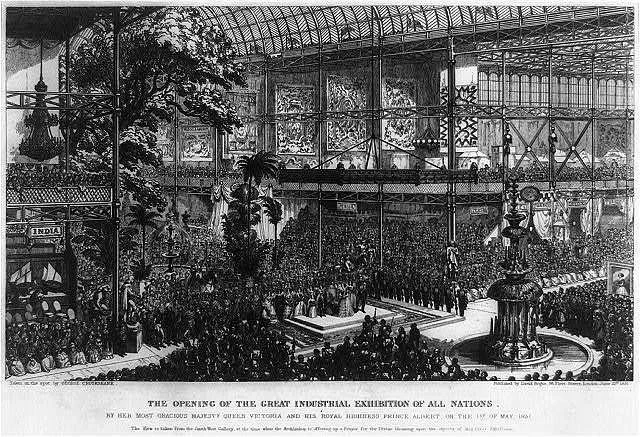
Opening of the Great Industrial Exhibition of all nations, by her most gracious majesty Queen Victoria and his royal highness Prince Albert, on the 1st of May, 1851. Print taken on the spot by George Cruikshank.
Without the excitement of Formula 1 to look forward to twenty-four weekends a year, the citizens and elites of the late nineteenth century entertained themselves with Grand Tours, grander ‘seasons,’ and the golden age of travelling exhibitions and World Fairs. These fairs saw complex envoys of professionals and celebrities toting innovative inventions across the globe to showcase their prowess, drawing massive crowds along the way. Promises of prizes and prestige motivated constant innovation and pushed the limits of technological advancement. Sound familiar?
Replace the professionals and celebrities with team principles and drivers, innovative inventions with the fastest cars in the history of the world, and if this logistical analogy continues, the stalls of cultures and nations with the hospitality tents and media pens of billion-dollar corporations.
Although large-scale fairs and exhibitions existed previously, the first ‘Great’ Exhibition took place in London in 1851, within the grandiose, purpose-built Crystal Palace. The exhibition, conceived by Prince Albert, Prince Consort of the United Kingdom, was meant to showcase the technological and cultural might of the British Empire, and, in doing so, stimulate international trade (and justify the imperial project). It also provided over six million visitors, at the time one-third of the UK population, the chance to marvel at an undeniable precursor to F1 cars – the steam engine.
The exhibition was, while not equally accessible, affordable for members of all classes, and 4.5 million of the visitors entered for a single shilling (5p). Visitors were “not mere observers,” but “participants,” with class-crossing crowds actively engaged in the consumption and production of trends and culture for the first time. The proceeds from the 1851 exhibition (£186,000) proved the economic boon that exhibitions brought to their host cities, and the funds were used to further develop the cultural and educational capital of the Empire’s capital city – bankrolling the construction of the Science Museum, Royal Albert Hall, Imperial College, and the Victoria & Albert Museum. Subsequent exhibitions have brought us the Eiffel Tower (Paris 1889), escalators (Paris 1900), Cherry Coke (Knoxville 1982), and, for the true crime fans among you, the world’s ‘first’ serial killer, H.H. Holmes (Chicago 1893).
However, it is vital to emphasize that these exhibitions were intimately tied to the most problematic aspects of colonialism and imperialism, and reinforced and justified racist, classist, and harmful social dynamics for the duration of the exhibition era.
A Brief History of Melbourne
Melbourne sits on land inhabited by the Wurundjeri Woi-wurrung and Bunurong/Boon Wurrung peoples of the Kulin Nation for millennia. The Traditional Place name of the city is Naarm, meaning ‘place’ in the Woiwurrung language.
The European settlement of Melbourne was founded on the banks of the river Yarra (Woiwurrung: Birrarung) in 1835 by a group of prospectors who had been unable to secure land in Tasmania. On the 6th of June, 1835, John Batman, alongside fellow members of the Port Phillip association, “purchased 600,000 acres of land from eight aboriginal chiefs.” The purchase, known as Batman’s Treaty, was later deemed invalid by the British government, whose terra nullis (nobody’s land) policy disregarded indigenous claims to their land, and thus already considered the region the property of the British crown.
In 1837, the land was surveyed by Robert Hoodle, and urban development began in force, with plans emphasizing the need for sweeping wide streets and classically European city blocks. The outpost was named Melbourne by its first colonial Governor after the Prime Minister, William Lamb, the 2nd Viscount of Melbourne. By 1841, the city had established markets for hay, corn, fruit, fish, and cattle, and in 1847, the settlement was officially declared a city by Queen Victoria.
Then, in 1851, while the Great Exhibition was enriching London, colonial settlers of Melbourne struck it rich, literally, when they discovered gold in the surrounding area, and the Victoria gold-rush began. For the next three years, an average of 90,000 people arrived in the state of Victoria each year, and even with this rapid rate of immigration gradually decreasing, by 1861 Melbourne had a population of around 140,000 settlers. This growth brought with it the first steam-operated trains and railways in Australia, the Melbourne Mint, and two major exhibitions.
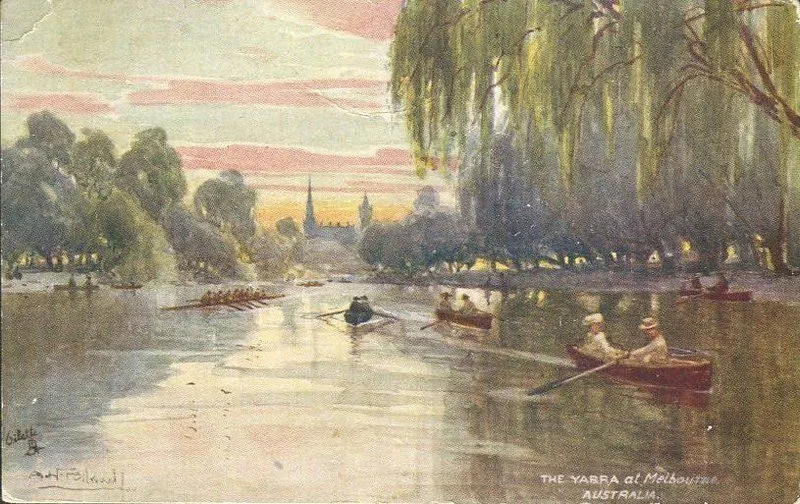
The Yarra River, Melbourne, Australia. Postcard produced by Raphael Tuck & Sons from 1903.
The 1880 and 1888 Exhibitions
Although Melbourne had built its own modest exhibition space from 1854, the international exhibition movement arrived in 1880. The city’s first international exhibition sought to highlight the growth and wealth of the state of Victoria (and react to the 1879 Exhibition put on by the city’s rival, Sydney). Now larger than many European capitals, Melbourne utilized the exhibition to install electric lights, telephones, and a tramline.
Just as the Crystal Palace was built for the 1851 exhibition, architect Joseph Reed was hired to build Melbourne’s own “palace of industry” in the newly refurbished and curated Carlton Gardens. However, unlike the Crystal Palace, a portion of the exhibition campus was intended to be permanent, and the central, grand Beaux-Arts style Exhibition Hall was built to serve as the city's enduring cultural venue. A substantial architectural project, the Hall is characterized by a central Florentine Duomo-inspired Dome, flanked by impressive rectangular wings to the east and west, and smaller transcepts to the north and south.
A cruciform-shaped temple to innovation.
-
Beaux-Arts is a lavish architectural style that developed in Paris through the 19th and 20th centuries. The style tends to emphasize symmetry and classical decoration. The large scale of Beaux-Arts buildings led to the adoption of the form for many public buildings, which lent the impression of grandeur, wealth, and power.
Although not the first international exhibition in the Southern Hemisphere — an accolade snatched up by Sydney the year prior — the 1880 Exhibition in Melbourne quickly set itself, and the city, apart.
The Carlton Gardens campus was filled to the brim with stalls and exhibits containing over “32,000 exhibits – artistic, manufactured and natural – from 33 countries.” Tickets costing as low as one shilling drew a crowd of 1.3 million visitors to a city whose population had ballooned to 282,000. Visitors were courted by the treats and trinkets of the exhibiting nations, and their walk through the park would have contained views of the following:
The immense success of the 1880 Exhibition and the massive crowds it drew also secured Melbourne as the host city of the national 1888 Australian Centennial Exhibition, an event which celebrated the one hundredth anniversary of the establishment of the first British penal colony in Botany Bay. Importantly, this event was not recognized as a ‘World’s Fair,’ which took place in Glasgow, Scotland that year.
Once again, the 1888 centennial celebrations were centered around the Exhibition Building, solidifying the building itself as a piece of local heritage. Significantly, this exhibition had a notably more nationalistic focus, meant to explicitly justify the endurance and glory of the British Empire in commemoration of 100 years of colonial rule. Outpacing the 1880 Exhibition, the centennial was visited by more than two million people, over two-thirds of the entire Australian population. These hordes of guests were treated to music performances by large choirs and sweeping symphonic orchestras. Over 3,000 paintings were displayed, including prominent works by British masters J.M.W. Turner and Frederic Leighton.
Unfortunately, recent reports suggest hosting the travelling exhibition of F1 at Albert Park will cost the city, not enrich it. Of course, the positive revenue of the event should not be overlooked — over the next ten years, the city is expected to welcome “465,000 people” who add “$320 million into the economy annually.” However, the event is backed by a government guarantee, meaning the taxpayers of Victoria subsidize host corporations wherever the event falls short. If the numbers published by the Victorian Parliamentary Budget Office are to be believed, these annual subsidies will add up to $1.7 billion by the end of Albert Park’s ten-year guaranteed contract, on top of the environmental impact that large-scale tourism and F1 as a sport bring to the table.

The south-facing side of the Royal Exhibition Building. Photograph, 2005.
Palace to Museum
World Fairs, now often known as ‘World Expos,’ organized by the Bureau International des Expositions, still occur regularly, but an influx of popular entertainment and ever-increasing globalization have rendered the ‘great’ exhibition era a thing of the past.
With its original purpose fading, the Exhibition Building was furnished with an aquarium, cyclorama, and small, permanent ethnographic collection, and spent the first half of the twentieth century as a theatre, concert, and events venue. In 1901 the building served as the venue for the opening of the first Parliament of the Commonwealth of Australia, with allegorical murals added to the dome’s interior in celebration.
A popular and extensive maze took up the space to the east of the building (before being replaced with a car park), and bike and motorcycle races were held on the oval track in the northern corner of the gardens. An annual motor show was regularly hosted at the site.
The hall briefly served as a hospital during the influenza outbreak of 1918, army barracks and training space through the Second World War, and a part-time migrant reception center for the Royal Air Force until 1962. In 1951, the ballroom hosted a grand reception for then-Princess Elizabeth’s royal tour, and the Grand Hall served as the venue for weightlifting and basketball at the 1956 Melbourne Olympics. The building was officially recognized by Queen Elizabeth II in 1980 for its centenary of cultural utility, and was renamed the “Royal” Exhibition Hall.
In 1995, the city announced an architectural competition for an extension in the northern section of the gardens, and between 1998 and 2000, a campus of modern, freestanding, and post-modernist buildings was constructed to host the Melbourne Museum. At 70,000 square meters, the museum is much larger than the Exhibition Building, and contains an incredibly diverse collection, displaying dinosaurs, gold-rush relics, and a replica wedding cake from the beloved Australian soap-opera Neighbors.
UNESCO Nomination
When the Royal Exhibition Hall and Carlton Gardens were listed together in 2004, they became Australia’s first World Heritage Listed sites listed under cultural, not natural, criteria. The nomination was justified through Criteria (ii), as a space which exhibited “an important interchange of human values,” and stands as a testament to “developments in architecture or technology, monumental arts, town-planning or landscape design.” The nominating text featured on the UNESCO website is as follows:
Thus, while certainly regarded for its architectural beauty, the Royal Exhibition Hall gained its nomination for standing as one of the great, enduring, physical monuments to the international exhibition movement, and as such, the first imperial-era, industrial-scale presentations of cultural innovation and exchange.
How to Visit
Located around 5 km north of the Albert Park racetrack, the Carlton Gardens are free to wander and accessible seven days a week. Visitors can enjoy peace and picnics in the scenic gardens, play on the expansive playground, or complete a free, self-guided, heritage walking tour.
The Melbourne Museum is open 9 a.m. - 5 p.m. daily. Tickets are free for children under 16 and museum members, while adult tickets range from $12-$18.
The Royal Exhibition Hall can only be visited through hour-long paid guided tours. Tours are available most days, and tickets range from $15 (children) to $29 (adult).
